
USCIS Field Offices Approved Far Fewer Citizenship Cases in Spring 2026, With San Jose Down 96%
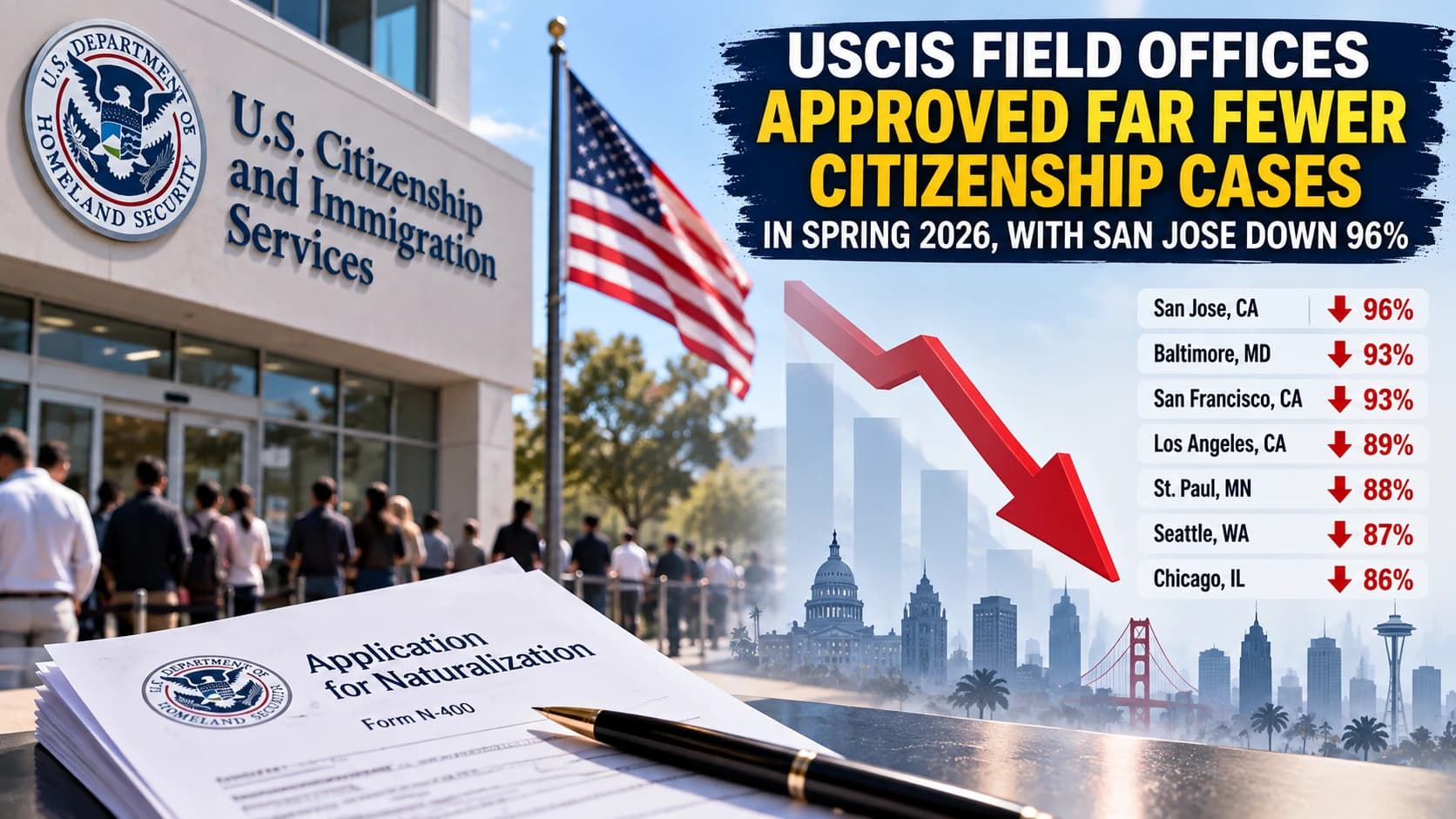
AI-generated illustration representing the reported decline in citizenship case decisions at USCIS field offices during spring 2026.
Photo: Arizona Asians / AI-generated image
USCIS field offices approved 57,697 naturalization applications from April through June 2026, a 76% drop from a year earlier, while pending cases climbed to 742,138. San Jose, Baltimore and San Francisco saw the steepest declines, as USCIS cited stricter reviews and expanded fingerprint re-checks.
U.S. Citizenship and Immigration Services field offices approved 57,697 naturalization applications in the second quarter of calendar 2026, a steep decline that left the agency with a growing backlog of citizenship cases across the country. The drop was especially pronounced in major urban offices, including San Jose, where approvals fell 96% from the same period a year earlier.
The slowdown affected applicants waiting for Form N-400 decisions at local USCIS offices nationwide, even as some locations continued to move cases at a steadier pace. Pending citizenship cases rose to 742,138 by June 30, 2026, up 40% from a year earlier, suggesting that filings continued to outpace completions during the spring quarter.
USCIS publishes quarterly office-by-office performance data for Form N-400, the application used by lawful permanent residents seeking naturalization. The figures show that decisions had already begun to fall in early 2026, after several quarters in which offices were generally approving about 91% of cases they decided.
Approvals fell faster than denials
Between April 1 and June 30, 2026, field offices received 145,872 new naturalization applications and decided about 70,500 cases, meaning applications arrived at roughly twice the pace of completions. Approvals fell to 57,697 from 241,326 in the same quarter of 2025, while denials declined to 12,808 from 23,269. Because approvals fell much faster than denials, the approval rate dropped to 81.8% from 91.2% a year earlier.
USCIS has not published a single explanation for the downturn tied directly to the quarterly numbers, but the agency has said it is carrying out more rigorous reviews. That shift came alongside several policy changes over the past year, including an August 2025 memorandum that urged officers to apply a more holistic good-moral-character standard in naturalization cases and to consider positive contributions as well as possible negative factors. USCIS also revived neighborhood investigations in that same policy package.
Another major change took effect on October 20, 2025, when USCIS began using the 2025 version of the civics test for certain applicants. In January 2026, the agency placed holds on pending benefit applications, including naturalization, for nationals of 39 countries under an expanded travel ban and began re-reviewing some approvals granted since January 20, 2021. On April 27, 2026, USCIS also began resubmitting fingerprints for most pending cases as part of an expanded FBI criminal-history check.
Law firms and advocates have said in public reporting that final approvals were largely paused until those fingerprint checks cleared, while officers were still able to move cases toward denial. The timing fits the quarterly data: the fingerprint re-vetting started four weeks into the April-to-June period, and approvals fell more sharply in that quarter than in the one before.
California offices took some of the biggest hits
The decline was not evenly spread across the country. Among offices that decided at least 500 citizenship cases in the spring quarter of 2025, 31 cut their decisions by three-quarters or more a year later, and three offices cut them by more than 90%. San Jose posted the steepest drop, deciding 408 cases in the spring of 2026 after deciding 9,281 a year earlier. Its pending caseload more than doubled to 20,899.
Baltimore and San Francisco each decided about 93% fewer cases than they had a year earlier, while Los Angeles fell 89%, St. Paul 88%, Seattle 87%, Chicago 86%, Fresno 86%, Harlingen 86% and Portland 85%. California as a whole saw the largest state-level decline: its field offices decided 7,515 N-400 cases in the April-to-June 2026 quarter, down from 45,528 in the same period of 2025, an 83% drop. The state’s pending caseload rose from 88,968 to 141,579.
Some offices remained comparatively steady. Des Moines decided 681 cases, slightly more than the 623 it decided a year earlier, and approved 93% of them. Lawrence, Massachusetts declined only 15%, and Pittsburgh fell 37%. Houston handled the largest volume in the country, deciding 4,878 cases and approving 91% of them, though that was still roughly half its 2025 level. Houston also had the largest pending caseload, at 31,057. Dallas followed with 3,358 decisions and 28,662 pending cases.
The sharpest changes in approval rates appeared in a handful of offices. New Orleans approved 45% of the cases it decided, down from 83% a year earlier. Queens approved 54%, down from 89%, even as it still decided 1,533 cases. Baltimore, Newark and Oakland Park, Florida, each approved 65%, while Miami approved 68%.
That does not mean those offices were denying more people. In Queens, for example, denials fell from 837 to 706 while approvals dropped from 6,985 to 827. The pattern suggests a process in which officers were still issuing some denials but were holding many approvals until additional screening steps were completed.
The swelling backlog means many applicants are waiting longer for final decisions. Because field offices received far more applications than they completed in the quarter, the queue grew by roughly 75,000 cases in three months. USCIS processing-time tools are updated monthly, but the quarterly N-400 data show that the naturalization pipeline was under heavy strain as of June 30, 2026.
For applicants, the disruption has been visible beyond the numbers. Oath ceremonies have been reduced in some cities, and local offices that once moved cases quickly have slowed markedly. The agency’s quarterly files indicate that the exact quarter when the downturn began cannot be pinned down precisely because USCIS has not published one of the intervening quarterly field-office datasets, but the decline was evident by the start of 2026 and deepened in the spring.
The latest figures point to a naturalization system where approvals, not just filings, have become the main bottleneck. Until USCIS publishes more detail on why the reviews are taking longer, the quarterly office data suggest that many applicants will continue to face uneven wait times depending on where their cases are being handled.
Source: U.S. Citizenship and Immigration Services
View original source ↗