
U.S. Mortgage Rates Rise to Highest Level Since July 2025
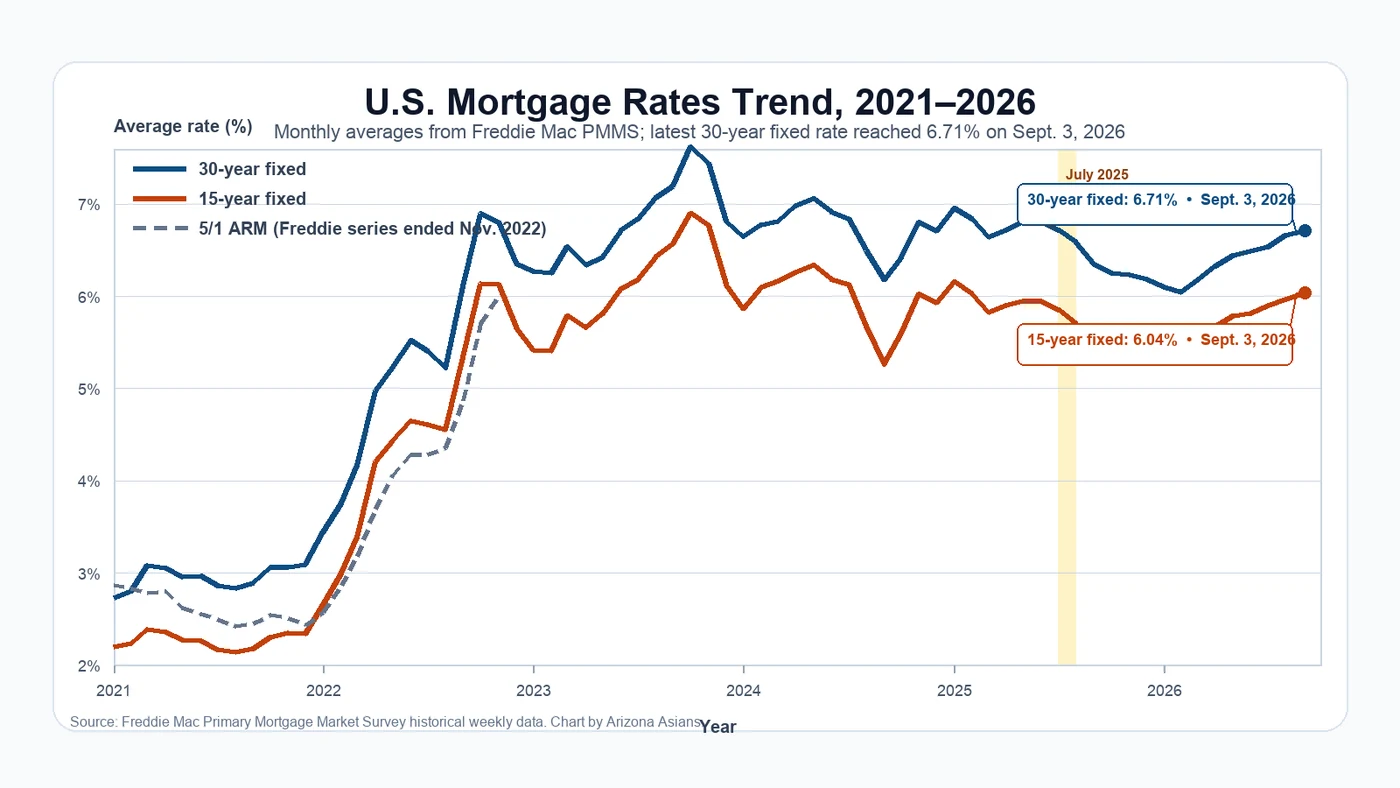
U.S. mortgage rates rose sharply after 2021 and remained elevated through 2026, according to Freddie Mac data.
Photo: Chart by Arizona Asians using Freddie Mac Primary Mortgage Market Survey data.
The average 30-year fixed mortgage rate rose to 6.71% this week, according to Freddie Mac, adding more pressure to homebuyers already facing high prices and affordability challenges.
U.S. mortgage rates climbed again this week, reaching their highest level since July 2025 and adding fresh pressure to buyers in an already difficult housing market.
According to Freddie Mac’s Primary Mortgage Market Survey, the average rate on a 30-year fixed-rate mortgage rose to 6.71% as of September 3, 2026, up from 6.66% the previous week. A year ago, the same rate averaged 6.50%. The last time Freddie Mac’s 30-year fixed mortgage rate was higher was July 31, 2025, when it averaged 6.72%.
15-Year Mortgage Rates Also Move Higher
The average rate on a 15-year fixed-rate mortgage also increased, rising to 6.04% from 5.98% the previous week. A year ago, the 15-year rate averaged 5.60%.
While 15-year loans usually carry lower rates than 30-year loans, they also require higher monthly payments because the loan is paid off more quickly. That makes them less practical for many first-time buyers, especially in expensive housing markets.
What This Means for Homebuyers
Higher mortgage rates reduce buying power because they increase the monthly cost of financing a home.
For example, even a small rate increase can make a noticeable difference on a mortgage payment, especially on homes priced above $400,000 or $500,000. Buyers may need to lower their price range, increase their down payment or delay purchasing until conditions improve.
Freddie Mac said purchase demand has remained relatively stable, suggesting that some buyers are adapting to the higher-rate environment. However, affordability remains a major challenge because rates are rising at the same time home prices, insurance costs and property taxes remain elevated in many markets.
Why Rates Matter in Arizona
The increase is especially relevant for Arizona, where fast-growing areas such as Phoenix, Mesa, Chandler, Gilbert, Scottsdale, Glendale and Peoria continue to attract new residents. For families considering a home purchase, higher rates can affect not only monthly payments but also loan qualification. Some buyers who qualified at lower rates may no longer qualify for the same loan amount. Higher borrowing costs can also affect builders, sellers and renters. If fewer buyers can afford homes, some households may remain in the rental market longer, adding pressure to rental demand.
A Housing Market Still Under Pressure
Mortgage rates are influenced by many factors, including inflation expectations, bond-market conditions, Federal Reserve policy and broader economic uncertainty.
Although mortgage rates do not move exactly with the Federal Reserve’s benchmark interest rate, they are closely connected to long-term bond yields, especially the 10-year Treasury yield. For now, buyers may need to prepare for a housing market where mortgage rates remain elevated and affordability remains tight.
What Buyers Can Do
Prospective buyers should compare offers from multiple lenders, review loan options carefully and avoid assuming that every lender will offer the same rate or closing costs. Buyers may also want to:
Get preapproved before shopping seriously
Compare fixed-rate and adjustable-rate options carefully
Review total monthly costs, including taxes and insurance
Avoid stretching beyond a comfortable payment
Ask about rate buydowns or seller concessions
Recheck rates frequently because they can change quickly
For homeowners, higher rates may make refinancing less attractive unless there is a specific financial reason to refinance.
The latest Freddie Mac data shows that the housing market remains sensitive to interest-rate movements. Until rates ease or incomes rise meaningfully, affordability will likely remain one of the biggest challenges for buyers nationwide.
Additional Reader Link:
Freddie Mac Mortgage Rate Archive: https://www.freddiemac.com/pmms/archive
Editorial Comment / Acknowledgement:
Sources: Freddie Mac Primary Mortgage Market Survey and Freddie Mac mortgage rate archive.
Topics
Source: Freddie Mac
View original source ↗Editorial Note: Sources: Freddie Mac Primary Mortgage Market Survey and Freddie Mac mortgage rate archive.