
Trump Uses U.N. Address to Defend Foreign Policy, Warn Iran and Predict End to Ukraine War
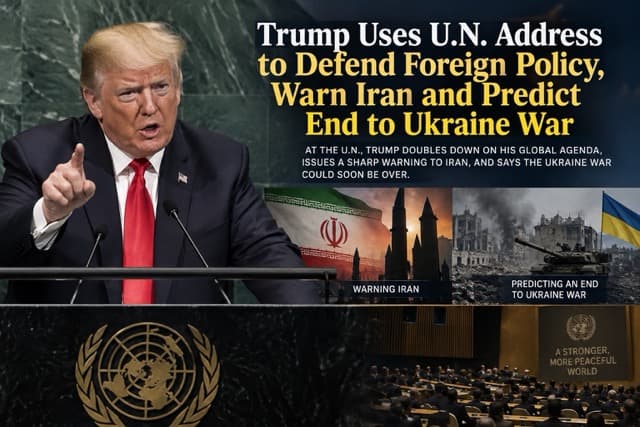
Trump Uses U.N. Address to Defend Foreign Policy, Warn Iran and Predict End to Ukraine War
Photo: AI Generated Image by Arizona Asians
President Donald Trump used his U.N. address to frame his foreign policy as strength and dealmaking, while issuing a stark warning to Iran and pledging that the war in Ukraine would end soon. The speech came as world leaders gathered in New York amid mounting concern over conflict, oil flows and the credibility of the United Nations.
President Donald Trump used his address to the United Nations General Assembly on Tuesday to defend his foreign policy approach, arguing that American strength and dealmaking remain central to resolving global conflicts.
Speaking as world leaders gathered in New York, Trump focused on several major international flashpoints, including Iran, Russia’s war in Ukraine, energy security and the role of the United Nations itself.
The speech came at a tense moment for global diplomacy. Governments are watching the war in Ukraine, instability in the Middle East, oil flows through critical shipping routes and growing questions about whether the United Nations can still play an effective role in preventing or resolving major conflicts.
Trump framed his administration’s approach as one based on pressure, negotiation and deterrence. He argued that unresolved conflicts should not be allowed to continue indefinitely and said his administration was working to end wars through direct engagement and leverage.
A major portion of the address focused on Iran. Trump issued a sharp warning to Tehran while also suggesting that a deal remained possible. His remarks reflected the administration’s broader position that Iran must not be allowed to threaten regional stability or disrupt energy flows.
The president also addressed Russia’s war in Ukraine, saying he expected the conflict to end soon. He did not provide a detailed timeline or a final agreement framework during the speech, but his comments came as diplomatic attention remains focused on whether Washington can push Moscow and Kyiv toward a ceasefire or negotiated settlement.
For many countries, the stakes extend beyond the battlefield. The wars and tensions discussed at the U.N. affect oil prices, shipping routes, food supplies, defense spending and the broader global economy. Any disruption in energy flows from the Middle East or escalation in Ukraine could quickly affect consumers, businesses and governments worldwide.
Trump also used the international platform to criticize what he views as weakness in global institutions. His remarks suggested that the United States would continue to emphasize national sovereignty, security and bilateral dealmaking over broad international consensus when American interests are at stake.
The address is likely to draw mixed reactions. Supporters may view it as a forceful statement of American leadership. Critics may argue that threatening language and unilateral pressure could make diplomacy more difficult, especially with Iran and other adversaries.
For Asian countries and Asian American communities, the issues raised in the speech have direct relevance. Energy security, trade stability, immigration policy, war risk and U.S. relations with countries such as India, China, Japan and Gulf nations are all shaped by decisions made in Washington and at international forums such as the United Nations.
The speech made clear that Trump intends to present foreign policy as a central part of his leadership message: strong warnings to adversaries, pressure for deals, skepticism toward global institutions and confidence that the United States can shape outcomes through power and negotiation.
Additional Reader Links
White House: https://www.whitehouse.gov/
UN Web TV: https://webtv.un.org/
Topics
Source: United Nations General Assembly / UN Web TV
View original source ↗Editorial Note: This article was prepared for Arizona Asians using public information from the United Nations General Assembly proceedings and related official sources. Speech transcripts and video archives may be updated after the event.