
The AI Data Center Boom: Trillions in Investment Are Reshaping Technology, Energy and Construction
Microsoft, Google, Oracle and other technology companies are pouring hundreds of billions of dollars into AI data centers, creating opportunities across semiconductors, construction, power, cooling and digital infrastructure.
Artificial intelligence is no longer just a software story. Behind every large AI model is a rapidly expanding network of data centers packed with processors, high-speed networking equipment, cooling systems and massive power infrastructure.
That buildout is now becoming one of the largest capital-investment cycles in the global economy.
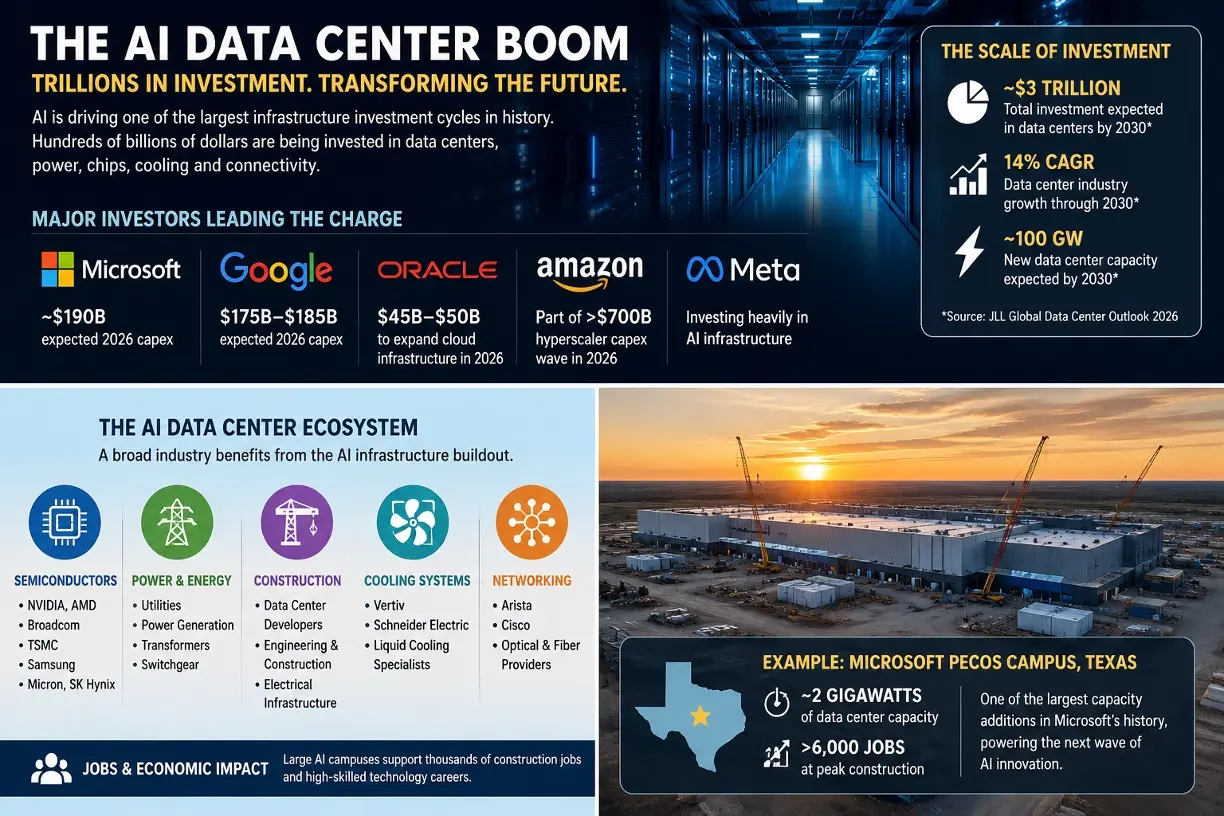
Microsoft says it expects to invest roughly $190 billion in capital expenditures during calendar year 2026, driven largely by cloud and AI infrastructure. Alphabet, Google’s parent company, expects $175 billion to $185 billion in 2026 capital spending, with the vast majority directed toward technical infrastructure such as servers, data centers and networking equipment.
The scale of spending illustrates how quickly AI is changing the economics of technology.
Data Centers Are Becoming the New AI Factories
Modern AI systems require enormous computing power. Training and operating advanced models involves thousands of specialized processors working together inside high-density data centers. These facilities require much more than buildings and servers. A large AI campus may need:
GPUs and CPUs
High-bandwidth memory
Advanced networking
Fiber connectivity
Electrical substations
Backup power
Liquid and air cooling systems
Large amounts of land and electricity
Microsoft recently announced a new data center campus in Pecos, Texas, expected to add approximately 2 gigawatts of capacity. The company described it as one of the largest single capacity additions in its history and said construction could support more than 6,000 jobs at peak build-out.
Microsoft and Google Lead a Massive Spending Wave
Microsoft is among the largest investors in the current expansion. During its fiscal third quarter, Microsoft reported $31.9 billion in capital expenditures, with about two-thirds directed toward short-lived assets such as GPUs and CPUs. The company expects quarterly spending to rise above $40 billion as it brings additional AI capacity online.
Google is pursuing a similar strategy. Alphabet says its 2026 capital expenditures could reach $175 billion to $185 billion. About 60% of its technical infrastructure investment is expected to go toward servers, while roughly 40% is directed toward data centers and networking equipment.
Alphabet has also moved directly into the energy-infrastructure side of the business. It agreed to acquire Intersect, a company involved in data-center and energy development, for approximately $4.75 billion plus assumed debt, demonstrating how closely AI infrastructure and electricity supply are becoming linked.
Oracle Expands to Meet AI Demand
Oracle is also investing aggressively in cloud infrastructure.
The company announced plans to raise $45 billion to $50 billion during calendar year 2026 to expand Oracle Cloud Infrastructure capacity. Oracle said the new infrastructure is intended to meet contracted demand from major customers including OpenAI, Meta, NVIDIA, AMD, TikTok and xAI. Oracle later reported that it raised $43 billion in debt and $5 billion in equity during fiscal 2026 as it continued expanding its AI cloud capacity.
This shows that the AI data-center boom is increasingly being financed not only from corporate cash flow but also through major debt and equity programs.
NVIDIA and Semiconductor Companies Are Major Beneficiaries
The companies building AI models and cloud platforms are only one part of the economic story. Chipmakers are among the biggest beneficiaries because AI data centers require specialized processors and memory. NVIDIA has become central to the AI infrastructure market because its GPUs are widely used for training and running large AI systems. Demand also benefits companies involved in semiconductor manufacturing, memory, networking chips and server systems. The broader beneficiary group includes companies such as AMD, Broadcom, TSMC, Samsung, Micron and SK Hynix, alongside server manufacturers and networking suppliers.
Power Is Becoming as Important as Computing
One of the biggest constraints on new AI data centers is now electricity.
The U.S. Energy Information Administration says data centers are becoming a major driver of American electricity-demand growth. EIA expects data-center server electricity consumption to increase substantially over coming decades, particularly in large standalone facilities.The agency also expects U.S. electricity consumption to continue rising through 2027, with large computing facilities among the principal reasons. That means the AI boom is creating opportunities well beyond Silicon Valley. Utilities, power-generation companies, electrical-equipment manufacturers, transformer suppliers, renewable-energy developers and grid operators are increasingly becoming part of the AI infrastructure ecosystem. Construction and Cooling Companies Also Stand to Gain. Building an AI data center requires significant civil, electrical and mechanical construction. Contractors are needed for:
Buildings and foundations
High-voltage electrical systems
Substations and transformers
Backup generators
Cooling plants
Water systems
Fiber networks
Security and monitoring
Cooling has become particularly important because increasingly powerful AI processors generate far more heat than conventional servers.
Companies providing liquid cooling, power management, switchgear, uninterruptible power systems and related equipment are therefore becoming increasingly important suppliers to the AI industry.
Arizona Could Benefit From the Expansion
The data-center boom is particularly relevant to Arizona.
The state already has a growing technology and semiconductor ecosystem, large areas suitable for industrial development and significant investment in power and digital infrastructure.
Arizona also benefits from its proximity to semiconductor manufacturing, including major investments around the Phoenix metropolitan area.
However, rapid data-center growth can also raise important questions about electricity availability, water use, land development and the impact of large industrial facilities on surrounding communities. For Arizona policymakers and businesses, the challenge will be attracting high-value technology investment while ensuring adequate power, water and infrastructure.
A Global Infrastructure Race
The United States remains the largest AI infrastructure market, but the expansion is increasingly global. Japan, India, Southeast Asia and the Middle East are attracting significant new data-center investment as governments and businesses seek local AI computing capacity, stronger cloud infrastructure and greater control over data. Countries with reliable electricity, strong fiber connectivity and favorable investment environments could become major beneficiaries of this next phase of digital infrastructure development.
More Than a Technology Investment Cycle
The AI data-center boom is creating an unusually broad economic ecosystem. Money spent by Microsoft, Google, Oracle, Amazon and other technology companies ultimately flows through semiconductor manufacturers, construction firms, electrical contractors, utilities, cooling-system manufacturers, network suppliers and real-estate developers. The result is that AI infrastructure is increasingly becoming an industrial-development story as much as a technology story. As companies race to secure computing capacity, the central question may no longer be simply who develops the best AI model.
It may increasingly be who can secure the chips, electricity, land and infrastructure needed to operate AI at enormous scale.
Suggested excerpt:
Category: Business & Technology
Suggested tags: Artificial Intelligence, AI Data Centers, Microsoft, Google, Oracle, NVIDIA, Cloud Computing, Data Centers, Arizona Technology, Energy Infrastructure
Sources: Official Microsoft, Alphabet, Oracle and U.S. Energy Information Administration releases and investor information.
Editorial note: Arizona Asians independently prepared this article using official corporate disclosures and U.S. government energy information. Investment plans and capital-spending forecasts may change.