
Partial Lunar Eclipse Tonight: What Arizona Skywatchers Can Expect
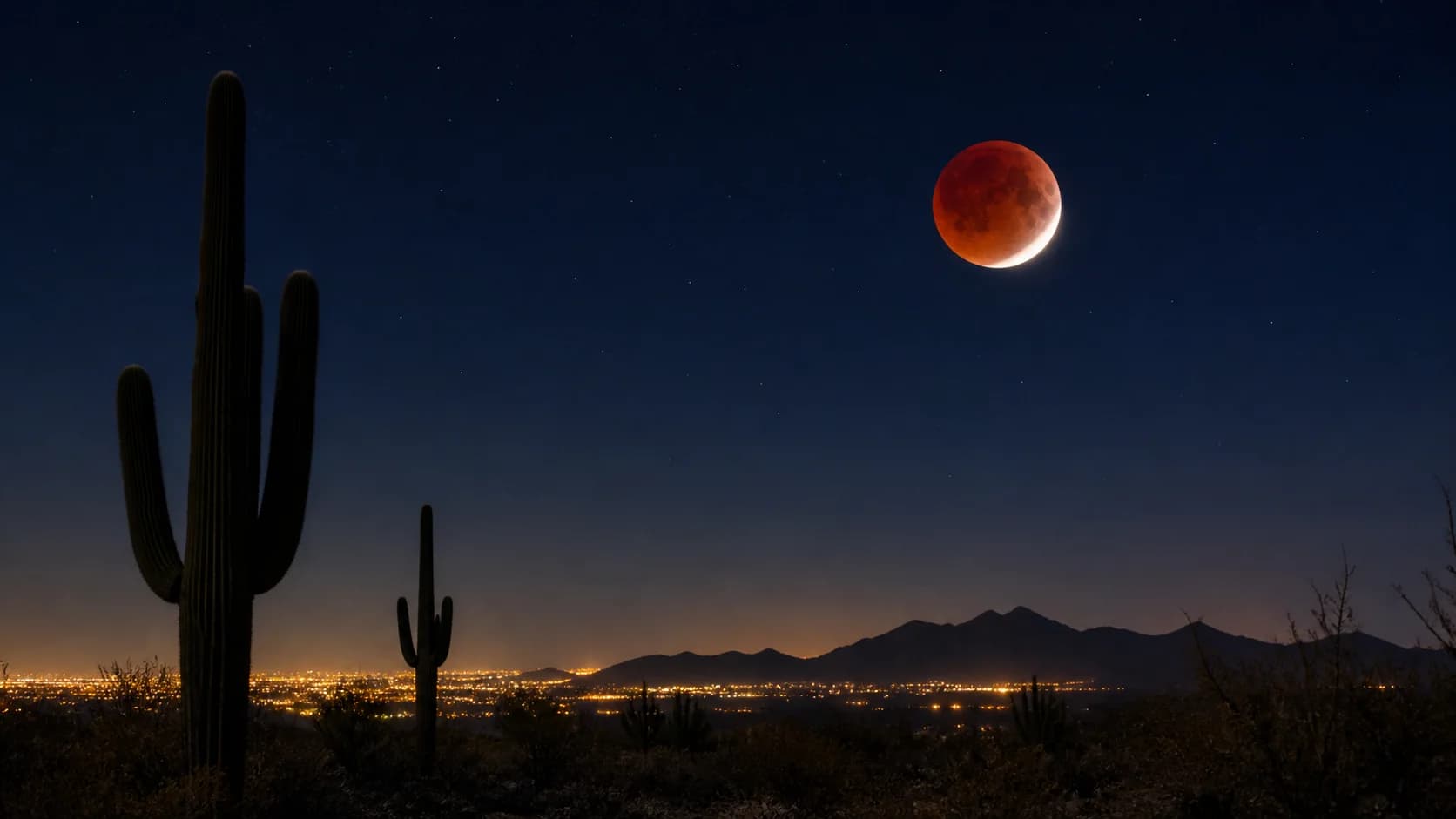
Depicting how the August 27, 2026 partial lunar eclipse may appear over Arizona’s desert sky.
Photo: AI-generated image by Arizona Asians
Arizona residents can watch a deep partial lunar eclipse tonight, August 27, with maximum eclipse around 9:12 p.m. MST in Phoenix as the Moon turns copper-red.
By Arizona Asians Staff
Arizona residents will have a chance to see a deep partial lunar eclipse tonight, Thursday, August 27, 2026, as the full Moon passes through Earth’s shadow and takes on a reddish-orange color.
NASA says the August 27–28 eclipse will be a partial lunar eclipse, not a total eclipse, but it will be a dramatic one. At maximum eclipse, about 96.3% of the Moon’s disk will be inside Earth’s dark central shadow, called the umbra.
How It Will Look in Arizona
In the Phoenix area, the Moon will rise while the eclipse is already underway. Viewers should look toward the east-southeastern sky shortly after moonrise.
For Phoenix, Timeanddate lists these local times:
Moonrise: about 6:51 p.m. MST
Partial eclipse begins: about 7:33 p.m. MST
Maximum eclipse: about 9:12 p.m. MST
Partial eclipse ends: about 10:51 p.m. MST
Penumbral eclipse ends: about 12:01 a.m. MST on Friday, August 28
At the peak, the Moon should appear mostly darkened, with a copper, orange or reddish tone. This color is often called a “blood moon,” although tonight’s event is technically a deep partial lunar eclipse.
Best Viewing Tips
No special glasses are needed. Unlike a solar eclipse, a lunar eclipse is safe to view with the naked eye.
For the best view:
Find a location with a clear view toward the east-southeast
Avoid bright city lights when possible
Use binoculars or a telescope for a closer look
Start watching soon after moonrise, but expect the best view around 9:12 p.m.
Check the local weather before heading out
Because the Moon will be low in the sky early in the evening, buildings, trees and mountains may block the view during the first part of the eclipse.
Why the Moon Turns Red
During a lunar eclipse, Earth moves between the Sun and the Moon, casting a shadow across the lunar surface.
The reddish color happens because sunlight passes through Earth’s atmosphere before reaching the Moon. Earth’s atmosphere scatters shorter blue light and lets more red and orange light pass through, creating the familiar copper glow.
A Sky Event for Families
The eclipse will be visible across much of the Americas, including Arizona. For families, students and astronomy lovers, it offers a simple way to enjoy a major sky event without special equipment. If skies are clear, tonight’s eclipse should be one of the most noticeable lunar events of the year for Arizona viewers.
Topics
Source: NASA
View original source ↗Editorial Note: NASA and Timeanddate eclipse visibility data for Phoenix, Arizona.