
Nepal’s leader calls deadly flood a warning to the world at the UN
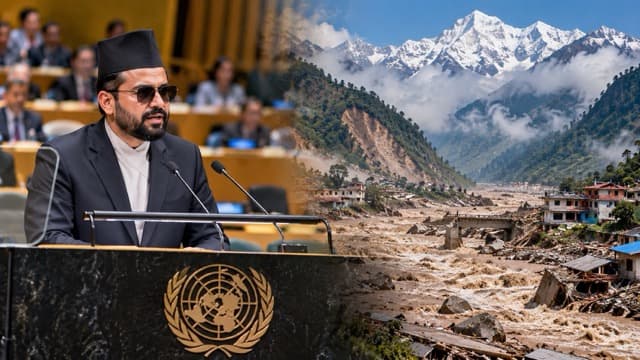
AI-generated illustration depicting Nepal’s appeal at the United Nations for stronger global action on climate change
Photo: Arizona Asians / AI-generated image
Nepal’s prime minister used the United Nations General Assembly to frame this year’s devastating Himalayan flood as more than a national disaster, urging richer nations to confront climate risks that are already hitting vulnerable countries. The remarks came as UN agencies continued emergency response work in flood-hit areas.
Nepal’s prime minister told the United Nations General Assembly that the country’s devastating flash flood was a warning for the wider world, casting the disaster as evidence of the accelerating dangers of climate change. The comments came as Nepal continues to deal with the aftermath of severe flooding and landslides that swept through the Himalayan region last month.
The remarks were aimed squarely at the international community, especially wealthier countries with high emissions and greater resources for adaptation and disaster response. Nepal has faced widespread damage to roads, bridges, homes and livelihoods, and UN agencies say the flooding has added to humanitarian and public health pressures in affected communities.
UN documents and humanitarian updates describe the disaster as a major transboundary event that began on 26 August 2026, when a high-intensity flood surge tore through the Bhote Koshi watershed and affected areas in Nepal and across the border in China’s Tibet region. The UN and partners launched a $49.6 million flash appeal on 4 September to support more than 84,000 people affected by the floods and landslides, which displaced entire villages in districts including Rasuwa, Nuwakot and Dhading.
A climate message from the Himalayas
In his address, the prime minister said the disaster should not be treated as an isolated event. The framing echoed UN climate warnings that extreme weather in mountain regions can have cascading effects far beyond national borders, particularly where communities depend on fragile infrastructure, steep terrain and seasonal water systems.
The UN’s own climate and humanitarian statements have recently highlighted Nepal as one of the places where flood risk, displacement and health concerns are converging. The World Health Organization said earlier this month that Nepal had strengthened disease surveillance in flood-affected areas to help detect possible outbreaks early and respond quickly.
The General Assembly remarks also come amid broader concern over glacier melt, flash floods and landslides across the Himalayas. UN officials have described the Nepal disaster as part of a wider pattern of climate-linked shocks facing vulnerable mountain communities, where warning systems, emergency access and recovery capacity can be limited by geography.
For Nepal, the immediate challenge remains recovery: clearing debris, restoring damaged routes and supporting families whose homes and livelihoods were lost or disrupted. The message delivered in New York was that the country’s losses are not only a domestic emergency, but also a sign of the risks that climate change is already producing in vulnerable parts of the world.
Topics
Source: United Nations General Assembly
View original source ↗