
Kīlauea Erupts Again as Episode 53 Sends Lava Fountains Above Hawaii Volcano
Kīlauea began its 53rd lava-fountaining episode on August 12, with fountains rising 80 to 100 feet above Halemaʻumaʻu crater. USGS says the eruption remains confined to Hawaiʻi Volcanoes National Park and does not currently threaten nearby communities.
Hawaii's Kīlauea volcano began a new episode of lava fountaining Wednesday afternoon, August 12, continuing a remarkable series of intermittent eruptions that has been unfolding at the volcano’s summit since December 2024.
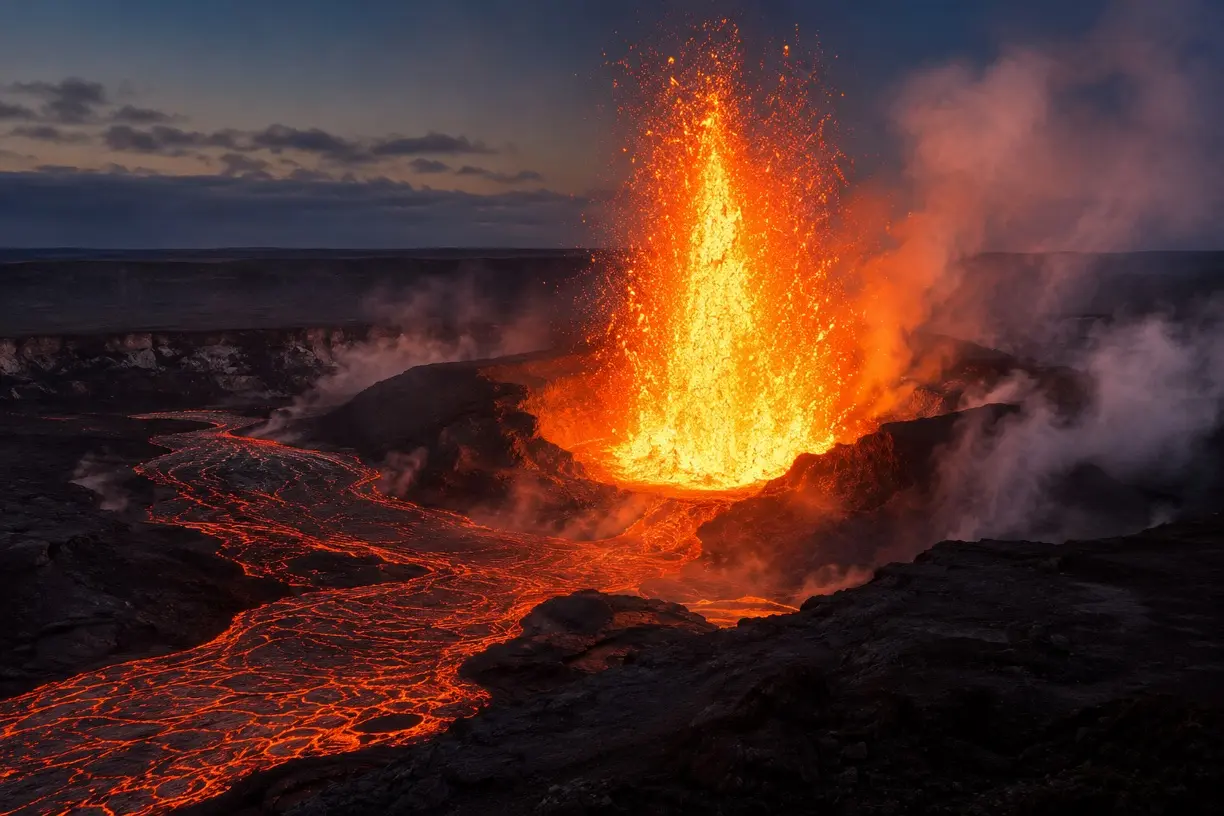
The U.S. Geological Survey’s Hawaiian Volcano Observatory said Episode 53 began at approximately 3:45 p.m. Hawaii Standard Time on August 12, with lava fountains emerging from the north vent inside Halemaʻumaʻu crater. At the time of the latest USGS update, fountains were reaching approximately 80 to 100 feet — about 25 to 30 meters — above the vent, and scientists expected them to grow higher during the early stages of the episode. The eruption prompted USGS to maintain Kīlauea at a WATCH volcano alert level, with an ORANGE aviation color code.
Lava Activity Builds Through the Day
Signs of renewed activity began several hours before sustained lava fountaining developed.
USGS monitoring cameras detected small amounts of spatter after 10 a.m., followed by a series of short-lived lava overflows beginning around 11:20 a.m. A more sustained flow developed around 1 p.m. and gradually increased. At approximately 1:45 p.m., scientists observed a sharp rise in lava output. A double-dome fountain formed and began feeding a broad overflow that extended more than 2,000 feet, or about 600 meters, from the vent. Additional overflows later emerged from the south vent before sustained fountaining began from the north vent.
Eruption Remains Inside the Summit Area
Despite the dramatic lava fountains, the current eruption does not pose an immediate threat to residential communities.
USGS says all eruptive vents and lava flows remain confined to Halemaʻumaʻu crater within Hawaiʻi Volcanoes National Park.
The National Park Service likewise says Kīlauea’s recent eruptive activity has remained inside the park and has not threatened homes or park infrastructure. No significant activity has been reported along Kīlauea’s East Rift Zone or Southwest Rift Zone in connection with the current episode. That distinction is important because eruptions along Kīlauea’s rift zones can potentially send lava toward populated areas, as occurred during the destructive 2018 eruption.
Volcanic Gas and Ash Remain Hazards
Even when lava remains confined to the summit, volcanic activity can create hazards beyond the crater itself. The latest USGS observations showed a volcanic gas plume rising approximately 6,000 feet above ground level. Winds near the vents were carrying volcanic emissions generally toward the southwest, while stronger winds at higher elevations could carry lighter volcanic material farther west. Kīlauea continuously releases gases including water vapor, carbon dioxide and sulfur dioxide during eruptions. Sulfur dioxide can react in the atmosphere to form vog, or volcanic smog. Vog can affect air quality and may cause breathing difficulties or other health problems, particularly for people with respiratory conditions.
AI Generated Image
Pele’s Hair and Other Volcanic Material
Lava fountains can also produce fragments collectively known as tephra. These can include volcanic ash, pumice, scoria and very thin strands of volcanic glass known as Pele’s hair, named after Pele, the Hawaiian deity associated with volcanoes and fire. USGS says heavier volcanic material generally falls close to the eruptive vents, while lighter particles can remain airborne and travel much farther depending on wind conditions. Residents and visitors are advised to limit exposure because volcanic fragments can irritate the skin, eyes and respiratory system.
More Than 50 Eruptive Episodes Since December 2024
The current activity is part of an eruption that began at Kīlauea’s summit on December 23, 2024. Since then, Halemaʻumaʻu has experienced more than 50 episodes of lava fountaining separated by pauses lasting from several days to weeks. Most of these eruptive episodes have lasted a day or less, according to USGS. The unusual episodic pattern has allowed scientists to observe cycles in which pressure builds beneath the summit during pauses and is released during renewed lava-fountaining events. Episode 53 follows Episode 52 as part of this continuing eruption sequence.
One of the World’s Most Active Volcanoes
Kīlauea is the youngest and most active volcano on the Island of Hawaiʻi and one of the most active volcanoes in the world.
The National Park Service says lava flows have covered nearly 90% of Kīlauea’s surface during the past 1,000 years, illustrating how frequently the volcano has reshaped the landscape. Kīlauea has experienced only relatively short periods of inactivity during recorded history.
Its summit, including Halemaʻumaʻu crater and the larger Kaluapele caldera, has undergone dramatic changes during recent eruptions.
Memories of the Destructive 2018 Eruption Kīlauea’s current summit eruption is very different from the major 2018 Lower East Rift Zone eruption, which affected populated communities outside Hawaiʻi Volcanoes National Park. During that eruption, lava covered approximately 13.7 square miles, destroyed more than 700 structures and caused an estimated $236 million in infrastructure damage. At the same time, tens of thousands of earthquakes accompanied a major collapse of Kīlauea’s summit caldera. The 2018 disaster remains an important reminder that the location of volcanic activity matters greatly when assessing the risk posed by Kīlauea. For Episode 53, scientists emphasize that the current lava remains confined to the summit area.
Spectacular — But Visitors Need to Be Careful
Kīlauea’s repeated lava fountains have attracted large numbers of visitors to Hawaiʻi Volcanoes National Park.
The National Park Service advises visitors to check current eruption information before traveling because eruptive episodes can begin and end quickly.
The park also warns that volcanic gases, unstable crater cliffs, earthquakes, cracks and rockfalls create significant hazards around the summit.
Areas immediately surrounding Halemaʻumaʻu have remained closed to the public because of these risks. USGS continues to monitor the volcano around the clock through seismic instruments, ground-deformation measurements, gas monitoring, satellite observations and webcams.
Topics
Source: U.S. Geological Survey — Hawaiian Volcano Observatory: Kīlauea Volcano Updates, including the August 12, 2026 notice announcing Episode 53.
View original source ↗