
Democrats Capture Congress in 2026 Midterms, Reshaping Washington
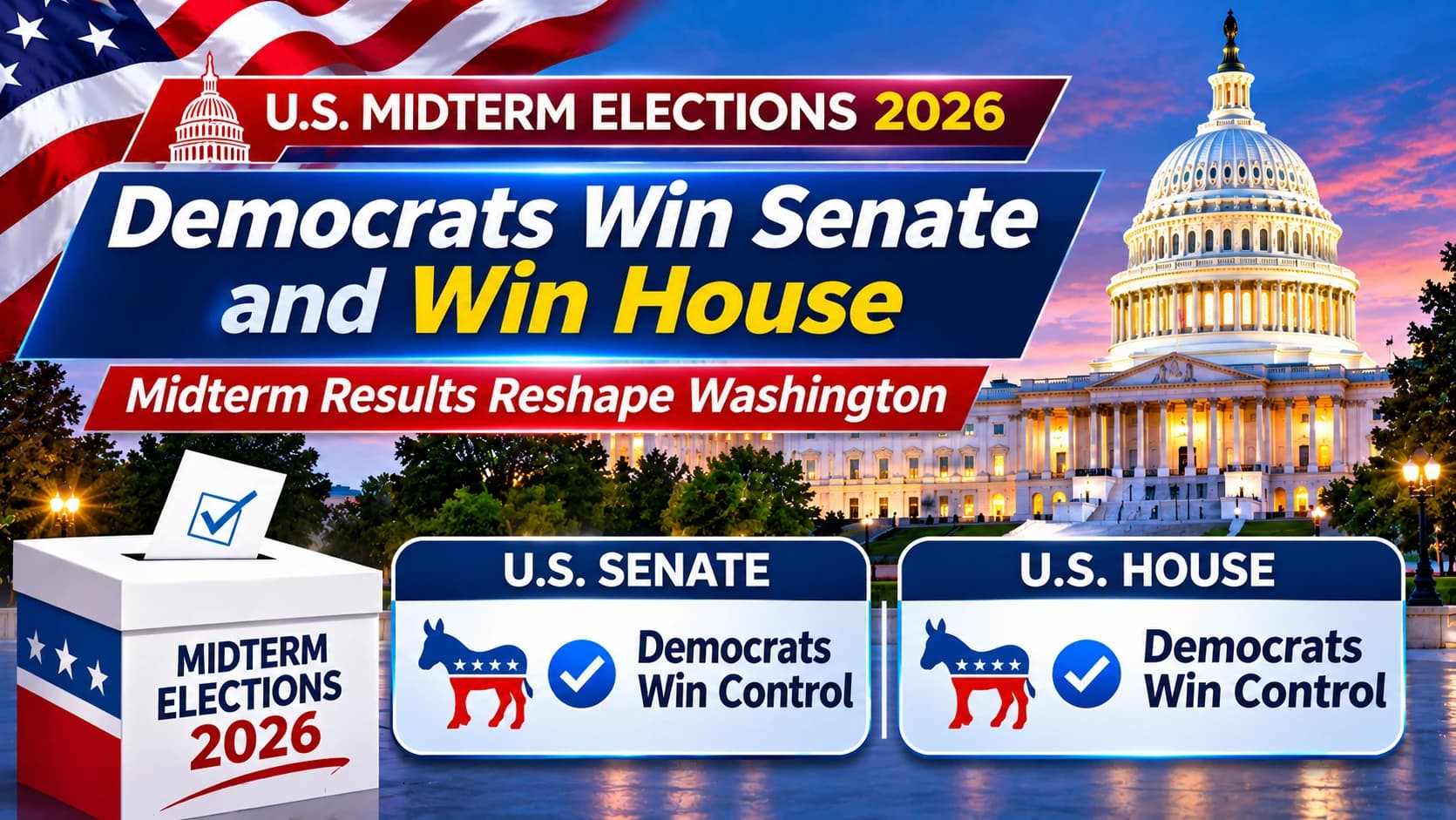
Democrats win U.S. Senate as midterm backlash reshapes Washington
Democrats won control of both chambers of Congress in Tuesday’s U.S. midterm elections, delivering a major political setback to President Donald Trump and ending two years of unified Republican control in Washington.
The Associated Press and Reuters reported that Democrats secured the Senate and gained enough House seats to take control of the chamber, giving the party substantial new influence over legislation, investigations and the administration’s agenda when the new Congress convenes in January.
Democrats take the Senate
The Senate was the more difficult chamber for Democrats going into Election Day.
Republicans entered the election with a 53-47 advantage, meaning Democrats needed several pickups while also protecting their own vulnerable seats.
By early Wednesday, Democrats and independents who caucus with them had secured a majority. The results included Democratic gains in states that had recently leaned Republican, helping produce a much stronger-than-expected showing.
One notable result came in Michigan, where Democrat Abdul El-Sayed won the open Senate seat and became the first Muslim elected to the U.S. Senate.
The Senate victory gives Democrats greater power over presidential appointments, judicial nominations and major legislation.
House shifts to Democratic control
Democrats also captured the House of Representatives after making gains across competitive districts and several traditionally Republican areas.
The AP reported that Democrats performed strongly across closely watched House contests, while Republican efforts to protect their majority through mid-decade redistricting did not prevent the chamber from changing hands.
Some individual races were still being finalized early Wednesday, but the broader outcome was clear: Democrats had won enough seats to control the House.
That means Republicans will lose the ability to independently set the House agenda when the next Congress begins.
Texas produces one of the night's biggest surprises
Texas emerged as one of the most striking stories of the election.
Democrats won several major contests in a state that has long been central to Republican national strength.
James Talarico won a U.S. Senate seat, while Gina Hinojosa defeated Republican Gov. Greg Abbott and became the first Latina elected governor of Texas.
Democrats also gained congressional seats despite district lines that Republicans had hoped would strengthen their position.
The Texas results were particularly significant because the state has been a dependable Republican stronghold in presidential and congressional elections for decades.
Cost of living and dissatisfaction with Washington drive voters
Economic concerns played a major role in the election.
Pre-election polling consistently showed the cost of living among voters’ top concerns. A Reuters/Ipsos survey conducted immediately before Election Day found that 78% of respondents considered the cost of living a very important or top voting issue.
AP and Reuters analyses also pointed to concerns about tariffs, government performance, the Iran conflict and dissatisfaction with the direction of the country as important factors influencing voters.
The election effectively became a national judgment on the Trump administration even though the president himself was not on the ballot.
What Democratic control means for President Trump
The results dramatically change the political environment for the final two years of Trump’s current term.
A Democratic House can conduct investigations, issue subpoenas and control committee agendas.
Democratic control of the Senate provides additional leverage over presidential nominees and legislation.
At the same time, control of Congress does not mean Democrats will be able to enact their entire agenda. Trump retains presidential veto power, and Senate rules can require broader support for many major pieces of legislation.
The most likely result is a period of increased political confrontation and divided government.
Democrats can block or reshape major administration initiatives, while Republicans can still use the White House to resist legislation they oppose.
Markets react to a divided Washington
Financial markets reacted quickly to the election outcome.
Global stocks initially moved as investors assessed the consequences of Democratic congressional control, including the possibility of greater scrutiny of artificial intelligence companies, financial institutions and other industries.
Markets also considered the possibility that divided government could slow major changes to taxes, spending and regulation.
AP reported that global markets were generally higher Wednesday as investors digested the result, while analysts noted that presidential veto authority and Senate procedural rules would continue to limit rapid policy changes.
A number of historic firsts
The 2026 election also produced several political milestones.
Among them was El-Sayed’s election as the first Muslim U.S. senator.
Other races produced historic representation in governor’s offices and congressional contests, reflecting continuing changes in the country’s political leadership.
Election Day largely peaceful
Despite concerns about possible disruptions, voting across the country proceeded with relatively few major problems.
The Associated Press reported that most election issues involved routine operational problems such as equipment delays and weather-related changes.
Authorities also responded to false claims circulating online about voting irregularities, while election officials said there was no evidence supporting several widely shared allegations of fraud.
Washington enters a new political phase
The biggest consequence of the 2026 midterms is straightforward: power in Washington has shifted.
Republicans began the election controlling the presidency, the House and the Senate.
When the new Congress convenes in January, Democrats will control both congressional chambers while Trump remains in the White House.
That arrangement sets up two years of divided government ahead of the 2028 presidential election.
For Democrats, the challenge will be turning electoral gains into an effective governing strategy.
For Republicans, the results raise questions about how the party responds to voter concerns over affordability, foreign policy and the administration’s agenda.
And for the White House, nearly every major legislative initiative will now require negotiation with a Congress controlled by the opposition party.
The 2026 midterms did more than change individual seats. They reset the balance of power in Washington and opened a new phase in American politics.
Topics
Source: Associated Press
View original source ↗