
Ancient Buddhist pilgrimage center near Varanasi gains global recognition for its spiritual, archaeological and artistic legacy
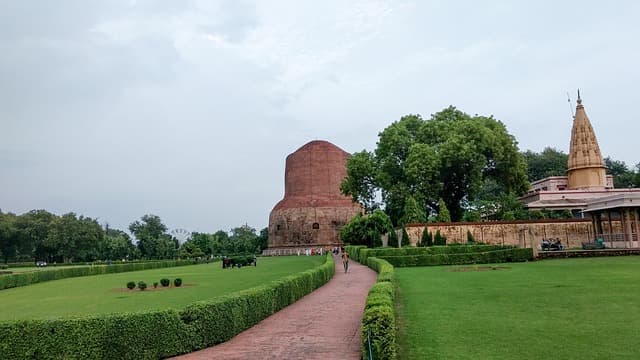
Ancient Buddhist pilgrimage center near Varanasi gains global recognition for its spiritual, archaeological and artistic legacy
Sarnath, one of Buddhism’s most sacred pilgrimage destinations, has been inscribed on the UNESCO World Heritage List, becoming India’s 45th World Heritage Site. The decision was announced on July 25, 2026, during the 48th session of the World Heritage Committee in Busan, Republic of Korea. UNESCO recognized the Ancient Buddhist Site of Sarnath for its exceptional religious, historical and cultural significance.
Located near Varanasi in Uttar Pradesh, Sarnath is traditionally regarded as the place where Gautama Buddha delivered his first sermon after attaining enlightenment at Bodh Gaya. According to Buddhist tradition, that teaching set in motion the spread of Buddhism and introduced principles associated with compassion, wisdom and peace. UNESCO
A Sacred Site With More Than 2,500 Years of History
Known in ancient Buddhist texts as Isipatana, Rishipatana or Mrigadava, Sarnath developed into a major center of Buddhist learning and pilgrimage over many centuries.
Royal patrons, monastic communities and devotees built stupas, temples, monasteries and other religious structures across the site. UNESCO’s newly inscribed property includes two protected archaeological areas: the Chaukhandi Stupa and the Archaeological Remains of Sarnath. UNESCO
Together, these monuments preserve the historic landscape associated with the Deer Park where the Buddha is believed to have met his first five disciples.
Dhamek Stupa and the Archaeological Complex
The Dhamek Stupa is one of Sarnath’s best-known monuments and is traditionally associated with the site of the Buddha’s first sermon.
UNESCO’s evaluation describes it as a Gupta-period structure, probably built over an earlier monument. Its cylindrical stone base features niches and elaborate carvings, while its upper structure was constructed of brick. UNESCO World Heritage Centre
The broader archaeological complex also contains the ruins of the Dharmarajika Stupa, temples, votive stupas and the foundations of several monasteries. These remains document Sarnath’s development as an evolving religious and educational center from the ancient period through approximately the 12th century. UNESCO World Heritage Centre
Ashoka’s Legacy at Sarnath
Emperor Ashoka played an important role in the development of Sarnath during the Mauryan period.
The remains of his sandstone pillar still stand at the site, while its famous Lion Capital is preserved at the Archaeological Museum in Sarnath. The four-lion sculpture later became India’s National Emblem.
UNESCO’s evaluation notes that the pillar provides physical and inscribed evidence of royal patronage and the formal establishment of Buddhism at Sarnath. The Lion Capital originally stood at the top of the pillar and included the Dharmachakra, or Wheel of Law, symbolically associated with the Buddha’s first sermon. UNESCO World Heritage Centre
A Center of Buddhist Art and Learning
Sarnath also became an influential center of sculpture and artistic production.
The Sarnath School of Art flourished across several historical periods and reached particular prominence during the Gupta era. Its sculptures became known for calm expressions, graceful proportions and refined depictions of the Buddha.
UNESCO’s evaluation states that artistic works produced at Sarnath helped spread Buddhist thought and imagery through sculptures, reliefs, terracotta objects and architectural ornamentation. UNESCO World Heritage Centre
That artistic influence extended beyond India and contributed to the development of Buddhist visual traditions across Central, East and Southeast Asia.
Global Recognition for a Universal Message
For Buddhists around the world, Sarnath remains one of the four principal pilgrimage sites associated with the life of the Buddha.
Its UNESCO inscription recognizes not only the surviving monuments, but also the site’s continuing spiritual importance and its role in the global transmission of Buddhist teachings.
The designation is expected to bring greater international attention to conservation, archaeological research and responsible tourism. UNESCO emphasized that safeguarding Sarnath is a shared responsibility for present and future generations. UNESCO
For Asian diaspora communities, including those in Arizona and across the American Southwest, Sarnath represents an important connection to a heritage that has shaped philosophy, art, ethics and religious life across Asia for more than two millennia.
Source: UNESCO and the UNESCO World Heritage Centre
View original source ↗